


- #China
- #Americas
- #JIIA Strategic Comments
- #Center for Disarmament, Science and Technology (CDAST)
- #Disarmament / Non-proliferation
- #CTBT
- #Science and Technology
- #CDAST
JIIA Strategic Comments (2026-23) The Shenzhen Summit and Its Nuclear Agenda
Nobumasa Akiyama(Director, Center for Disarmament, Science and Technology)

Papers in the "JIIA Strategic Commentary Series" are prepared mainly by JIIA research fellows to provide comments and policy-oriented analyses of significant international affairs issues in a readily comprehensible and timely manner.
Key Points
- At their first trilateral summit in Shenzhen, the United States, China, and Russia reaffirmed the principle that nuclear war must be prevented and agreed to hold talks on nuclear risk reduction and nonproliferation. The declaration included no concrete measures to reduce nuclear arsenals or end the war in Ukraine. For China and Russia, the summit was an opportunity to demonstrate their standing as major powers by discussing the international order alongside the United States.
- Nuclear arms control faces two parallel challenges: restoring limits on U.S. and Russian strategic nuclear forces along with mutual verification, and bringing China into talks on nuclear risk reduction. The three countries also differ on how they define strategic stability and what conditions are needed to sustain it.
- The declaration called for nuclear nonproliferation but made no mention of the Treaty on the Non-Proliferation of Nuclear Weapons (NPT) or the obligation under Article VI to pursue negotiations on nuclear disarmament. Future talks should address practical risk reduction measures, including crisis communications and advance notification of missile launches.
- If Beijing expects Washington to prioritize stable relations with China and hold back from responding in the Taiwan Strait or the East China Sea, it may step up coercion below the threshold of armed conflict. If U.S. allies come to the same conclusion, their confidence in U.S. extended deterrence could erode. Japan should support the nuclear dialogue and consult with Washington as the agenda takes shape. The two allies should clearly communicate their approach to regional deterrence and crisis response.
- If talks among the major powers extend to arrangements affecting regional security, Japan should seek a role for itself and other regional stakeholders. Japan should also work with a broad range of countries to support the independence of the International Criminal Court (ICC) and uphold UN Charter principles such as sovereign equality and the prohibition on territorial change by force.
Introduction
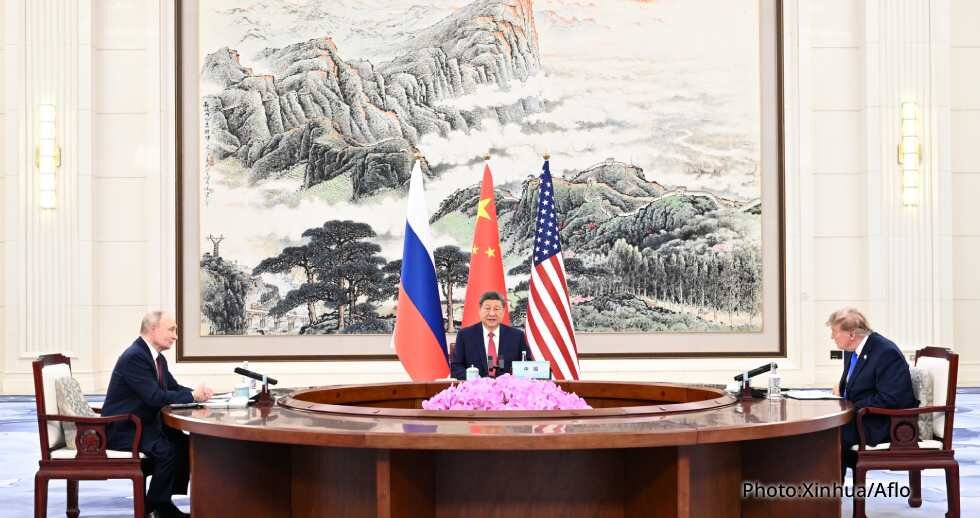
On November 19, the United States, China, and Russia held their first trilateral summit in Shenzhen, China, on the sidelines of the Asia-Pacific Economic Cooperation (APEC) leaders’ meeting. The three leaders issued a “Declaration toward Peace.”1 The sight of three major-power leaders convening to discuss the international order evokes the 1945 Yalta Conference, where Allied leaders discussed how to draw the boundaries of postwar spheres of influence. Shenzhen was an event of very different historical significance. The declaration went only as far as reaffirming principles on which the three countries’ interests coincided. On nuclear issues, the three agreed to discuss risk reduction and nonproliferation. The declaration contained no measures to constrain their nuclear forces. U.S. President Donald J. Trump could point to the prospect of a three-way nuclear dialogue. The more tangible gains, including relief from sanctions on Russia and a chance to assert major-power status, went largely to Chinese President Xi Jinping and Russian President Vladimir Putin. For Putin, having a seat alongside the United States and China to discuss global security was an achievement in itself. With Russia’s resources strained by the war in Ukraine and its dependence on China deepening, the meeting gave him a chance to project Russia’s standing as a major power at home and abroad. Xi, for his part, could present China as acting on an equal footing with the United States in addressing global affairs.
For Japan, the question is how this nuclear dialogue will affect security in the Taiwan Strait and the East China Sea, as well as Japan–U.S. alliance commitments, including nuclear reassurance.
The Four Points of the Declaration
The declaration said that the three countries would work on United Nations (UN) reform in their capacity as permanent members of the Security Council. It also called for increasing the production and supply of refined petroleum products. On the International Criminal Court (ICC), the declaration stressed state consent and the immunity of public officials and warned against abuse of jurisdiction. On nuclear issues, the three reaffirmed the principle of preventing nuclear war and pledged to hold talks on nuclear risk reduction and nonproliferation.2
The declaration omitted the two objectives Trump had raised at the start of the meeting: nuclear arms reductions and an end to the war in Ukraine. The three countries also failed to agree on the mechanisms Xi had proposed for crisis communications and the prevention of clashes. They have yet to say who will lead the nuclear dialogue or when the next meeting will take place.3
Bilateral Interests at the Trilateral Summit
Before the trilateral summit, Trump met separately with Xi and Putin. According to the Chinese readout, the U.S. and Chinese presidents agreed to draw up an action plan for the “constructive relationship of strategic stability” they had set out at their May summit in Beijing. Xi urged the United States to handle the Taiwan issue with care. Trump reportedly reiterated the longstanding U.S. position of not supporting Taiwan independence. Beijing treats Taiwan as an issue that bears on the stability of the U.S.–China relationship as a whole. Around the same time, the United States published a rule restricting Chinese companies’ remote access to advanced artificial intelligence (AI) chips through cloud services and other channels. Even as the two presidents discussed how to manage their differences, the United States and China continued to compete over advanced technology.
Before the trilateral summit, Trump met separately with Xi and Putin. According to the Chinese readout, the U.S. and Chinese presidents agreed to draw up an action plan for the “constructive relationship of strategic stability” they had set out at their May summit in Beijing. Xi urged the United States to handle the Taiwan issue with care. Trump reportedly reiterated the longstanding U.S. position of not supporting Taiwan independence. Beijing treats Taiwan as an issue that bears on the stability of the U.S.–China relationship as a whole. Around the same time, the United States published a rule restricting Chinese companies’ remote access to advanced artificial intelligence (AI) chips through cloud services and other channels. Even as the two presidents discussed how to manage their differences, the United States and China continued to compete over advanced technology.
The agreement on refined petroleum products followed a U.S. request in September that China increase production and a U.S. decision in October to temporarily authorize transactions involving Russian diesel. The declaration specified neither supply volumes nor a deadline. Stable fuel prices are in Japan’s interest as well. A widening of exemptions from sanctions on Russia, however, would undermine Western unity on Russia policy.
Major-Power Discretion on the ICC and UN Reform
The three countries’ interests coincided on the question of ICC jurisdiction. None of the three is a party to the Rome Statute. The ICC has issued an arrest warrant for Putin in connection with the situation in Ukraine, and in August 2026 the United States imposed sanctions on ICC President Tomoko Akane. Under the Rome Statute, the Court can, in certain circumstances, exercise jurisdiction over nationals of nonparties, including for crimes committed on the territory of a state party. By stressing state consent and the immunity of public officials, the three leaders appear to have sought to curb such exercises of jurisdiction.
On UN reform, the three countries emphasized their status as permanent members of the Security Council. Xi and Putin also invoked their countries’ history as victors in World War II. Since November 2025, China has cited the UN Charter’s enemy state clauses in its dispute with Japan, which gives this emphasis on wartime victory particular significance for Japan. While Japan and others call for a more representative Security Council, the declaration offered no specific proposals on its composition or on the veto.
Agreement on wording in Shenzhen was possible where the three countries’ interests overlapped. The declaration was silent on issues where those interests clash, including the war in Ukraine. The danger to watch for is that major powers may strike deals on individual issues without giving countries in the region an adequate say. If that happens, the comparison with Yalta will acquire a more troubling significance.
Preventing Nuclear War and the Challenges of Arms Control
Paragraph 4 of the “Declaration toward Peace” reaffirmed the principle that “a nuclear war cannot be won and must never be fought,” stated in the 1985 joint U.S.–Soviet statement by Ronald Reagan and Mikhail Gorbachev and again in the 2022 joint statement of the five nuclear-weapon states. The reaffirmation gives Trump a basis for presenting the summit as part of an effort to bring China into arms control, a process historically centered on U.S.–Soviet and then U.S.–Russia negotiations. In 1985, working-level talks were already underway, so Reagan and Gorbachev could direct their negotiators to accelerate the talks and could refer to the principle of 50 percent reductions in nuclear arms and the idea of an interim agreement on intermediate-range nuclear forces (INF). Turning the principle reaffirmed in Shenzhen into nuclear arms reductions will take lengthy negotiations over which forces to cover, how to verify reductions, and other issues.
Xi likened nuclear weapons to a “sword of Damocles” hanging over humanity and called for their complete prohibition and total elimination. U.S. President John F. Kennedy used the same image in his 1961 address to the UN General Assembly to warn that nuclear war might begin by accident or miscalculation. Xi himself used it in a 2017 speech in Geneva. In October, China’s Foreign Ministry ruled out joining trilateral nuclear disarmament negotiations at this stage, citing the disparity between China’s nuclear forces and those of the United States and Russia. Xi’s own acknowledgment of nuclear risks could give Trump an opening to seek talks with China on crisis management and greater transparency.
At Davos in 2025, Trump had already raised the idea of bringing China into U.S.–Russia nuclear talks. Since the New Strategic Arms Reduction Treaty (New START) expired in February 2026, the United States has faced two tasks at once. It needs to reestablish limits on strategic nuclear forces and mutual verification with Russia while responding to China’s nuclear buildup. In September 2025, ahead of the treaty’s expiration, Russia said it would observe the treaty’s central numerical limits for a year afterward if the United States did the same. Moscow maintained that position after the treaty expired. If Washington and Moscow fail to put forward some form of arrangement by the time that one-year period ends in February 2027, the limits on strategic nuclear forces will effectively lapse. China maintains that the United States and Russia, with their larger arsenals, should make reductions first.
How the three countries understand the reference to “maintaining strategic stability” in the declaration’s preamble will also shape the course of their nuclear dialogue. U.S. thinking on arms control has traditionally focused on the balance of nuclear forces and on reducing incentives for a first strike or an arms race. China attaches greater weight to stability in the overall political relationship and treats respect for its “core interests,” including Taiwan, as a condition for that stability. In describing the “constructive relationship of strategic stability,” the United States emphasized “fairness and reciprocity.” Broader conceptions of strategic stability also figure in U.S. debates, though Washington and Beijing still differ on what stability requires. Russia has framed strategic stability as a “security equation” that encompasses missile defense, conventional precision strike, space, and even NATO enlargement.
Even between the United States and Russia, nonstrategic nuclear weapons and new types of nuclear weapons, such as nuclear-powered cruise missiles and nuclear torpedoes, along with conventionally armed hypersonic weapons and missile defense, complicate the traditional calculus centered on strategic nuclear warhead counts. In a tripolar system that includes China, the United States may seek forces sufficient to deter both China and Russia, while each of those countries seeks to maintain the forces it needs to deter the United States. In that case, a buildup or reduction by any one country would affect the force calculations of the other two. Finding a balance acceptable to all three will be difficult.
Nonproliferation raises a further question. At the opening of the summit, Trump stressed the importance of working together to prevent nuclear weapons from spreading to other countries. “That’s what we’re doing in Iran,” he said, casting his Iran policy, including military action, as part of that effort. Xi called for compliance with the Treaty on the Non-Proliferation of Nuclear Weapons (NPT). The 2022 joint statement of the five nuclear-weapon states explicitly cited the obligation to pursue disarmament negotiations under Article VI of the NPT. The Shenzhen declaration referred to neither the treaty nor Article VI. A major-power dialogue on “nonproliferation” that leaves out the NPT and its disarmament obligations could become a means for those powers to police proliferation while setting aside their own responsibilities. If the three countries take up nonproliferation, the nuclear-weapon states’ disarmament responsibilities should also be on the agenda.
The impact of AI on decisions to use nuclear weapons is another possible topic for nuclear risk reduction talks. Introducing AI into early-warning and decision-support systems can shorten the time leaders have to make decisions, and improved detection can raise doubts about the survivability of retaliatory forces. Even when the final decision rests with a human, relying on AI to filter and assess the information behind that decision can aggravate a crisis through false alarms or excessive trust in machine judgments. Alongside procedures for communicating in a crisis, the three countries could usefully discuss procedures to guard against misperception. At their 2024 meeting in Lima, the U.S. and Chinese presidents affirmed the need for human control over decisions to use nuclear weapons. Before the Shenzhen summit, reports suggested that working-level discussions among the three countries could yield a relatively easy agreement that would leave each country’s nuclear posture intact. AI went unmentioned in both the declaration and the leaders’ published remarks. The reasons are unclear. Russia was not a party to the agreement the United States and China reached in 2024, and its position may have been an obstacle. The fact that even the issue considered easiest to agree on produced no written outcome shows how little common ground the three countries have at the start of this dialogue.
Implications for Japan
Japan should support the trilateral nuclear dialogue and consult with the United States from the earliest stages of preparation to develop a common understanding. Prime Minister Sanae Takaichi expressed confidence that the summit would not harm Japan’s interests. At the June Japan–U.S. Extended Deterrence Dialogue, Japan had also urged the United States to pursue multilateral talks on strategic stability, including arms control dialogue with China and Russia. The next step is to exchange views while the United States sets its agenda, so that Japan can assess at an early stage how any proposed agreement might affect its security. Japan can also make common cause with South Korea, Australia, and U.S. allies in Europe on the need for advance consultations.
If Beijing expects Washington to hold back in the Taiwan Strait or the East China Sea to avoid damaging relations among the major powers, it may conclude that it has more room for coercion and gray-zone activity below the threshold of armed conflict. The “stability–instability paradox,” in which strategic stability can encourage conflict at lower levels, arises when mutual nuclear vulnerability gives both sides a reason to avoid escalation. The Shenzhen nuclear dialogue does not by itself create that structure. The same logic would apply, however, if Beijing came to expect Washington to be less willing to risk escalation. The problem could also arise outside the nuclear relationship if an improvement in U.S.–China political relations were interpreted the same way. If allies, too, come to expect U.S. restraint in responding to regional coercion, their confidence in extended deterrence could weaken and calls for independent nuclear arsenals could gain traction.
Japan and the United States have two tasks. First, they should strengthen conventional deterrence by denial and deepen consultations on how to share roles, missions, and capabilities and on how to integrate nuclear and conventional capabilities. The aim is to deter aggression in the region and manage escalation in a crisis. Second, they should agree on the purpose and scope of U.S. discussions with China and Russia on strategic stability, and make clear how the alliance would respond to coercion in the Taiwan Strait and the East China Sea. This would give Beijing less room to portray nuclear risk reduction talks as evidence that Washington has accepted China’s “core interests.”
Japan and the United States differ on questions of international order. Japan is the largest contributor to the ICC’s assessed budget and has expressed regret over the sanctions against President Akane. As Washington joins Beijing and Moscow in seeking to constrain the ICC, Japan should continue to convey its support for judicial independence to the United States. When China and Russia invoke their status as wartime victors, Japan should bring the discussion back to present-day conduct and ask who is upholding the UN Charter’s principles, including sovereign equality and the prohibition on changing borders by force, and who is undermining them. The General Assembly recognized as early as 1995, in Resolution 50/52, that the enemy state clauses were obsolete. Working with a wide range of countries to uphold the Charter’s principles would also support the regional order that the Japan–U.S. alliance seeks to preserve. Countries in the Global South may share Japan’s concern about the fate of small and medium-sized states being decided in bargains among major powers.
Conclusion
Despite their differing conceptions of strategic stability, the United States, China, and Russia agreed in Shenzhen on the principle of holding talks on nuclear risk reduction and nonproliferation. It remains very much in doubt whether they can settle on a date and designate leads for the next meeting, let alone reach concrete agreements on advance launch notifications or crisis communications. In that sense, Trump appears to have won the diplomatic credit, while Xi and Putin came away with the substantive gains.
Japan should support U.S.–Russia arms control and trilateral efforts to reduce nuclear risks. It should also consult closely with the United States on issues affecting regional deterrence and crisis response, and ensure that the two allies send a common message. If the major-power talks extend to arrangements affecting regional security, Japan should seek the participation of the countries directly concerned, including Japan itself.
Japan’s fundamental tasks are the same as they were before the summit.
- China, Russia, and the United States, “China-Russia-U.S. Heads of State Declaration toward Peace,” November 19, 2026, paras. 1–4, Xinhua English text, State Council of the People’s Republic of China, https://english.www.gov.cn/news/202611/19/content_WS6afeda1ac6d00ca5f9a0e790.html; Embassy of the People’s Republic of China in the United States, “China-Russia-U.S. Heads of State Declaration toward Peace” (in Chinese), November 19, 2026, https://us.china-embassy.gov.cn/zgyw/202611/t20261119_12063191.htm.; The White House, “U.S.-Russia-China Heads of State Declaration toward Peace,” November 19,2026, https://www.whitehouse.gov/briefings-statements/2026/11/u-s-russia-china-heads-of-state-declaration-toward-peace/.
- China, Russia, and the United States, “Declaration toward Peace,” paras. 1–4.
- Josh Boak, Michelle L. Price, and E. Eduardo Castillo, “China and Russia Say They and US Agree on UN Reforms, Boosting Fuel Supplies, Dialogue on Nuclear,” Associated Press, November 19, 2026, https://apnews.com/article/a04dc76ed8e786b087e2c1ea9598783a; Cao Jiayue and Deng Hua, “Xi Jinping Sets Out Four Views on How Major Powers Should Get Along” (in Chinese), Xinhua, republished by People’s Daily Online, November 19, 2026, https://politics.people.com.cn/n1/2026/1119/c1024-40837188.html; China, Russia, and the United States, “Declaration toward Peace,” para. 4.
- Jarrett Renshaw and Trevor Hunnicutt, “China and Russia Release ‘Peace Declaration’ after Trump, Xi, Putin Meeting,” Reuters, November 18, 2026 (UTC), https://www.reuters.com/world/china/trumps-historic-meeting-with-xi-putin-headlines-asia-trip-2026-11-18/; Ministry of Foreign Affairs of the People’s Republic of China, “President Xi Jinping Meets with U.S. President Donald J. Trump,” November 19, 2026, https://www.mfa.gov.cn/mfa_eng/xw/zyxw/202611/t20261119_12063139.html; “China’s Xi Says US Should Do ‘Right Thing’ on Taiwan to Avoid Setbacks in Relations,” Reuters, November 19, 2026, https://www.reuters.com/world/china/chinas-xi-says-us-should-do-right-thing-taiwan-avoid-setbacks-relations-2026-11-19/.
- Bureau of Industry and Security, “Addressing Remote Access to Advanced Semiconductors,” Federal Register 91, no. 222 (November 19, 2026): 74970, https://www.govinfo.gov/content/pkg/FR-2026-11-19/pdf/2026-23529.pdf.
- Ben Aris, “Russia’s Putin Talks Ukraine with Trump in Shenzhen, Announces Nothing,” bne IntelliNews, November 19, 2026, republished by Yahoo News, https://www.yahoo.com/news/world/articles/russias-putin-talks-ukraine-trump-082115095.html.
- Ministry of Foreign Affairs of the People’s Republic of China, “President Xi Jinping and Russian President Vladimir Putin Meet the Press,” May 20, 2026, https://www.fmprc.gov.cn/mfa_eng/xw/zyxw/202605/t20260520_11914662.html; Alexander Knobel and Alexander Firanchuk, “Russia’s Foreign Trade in January–July 2026,” Gaidar Institute for Economic Policy, October 12, 2026, https://www.iep.ru/en/monitoring/russia-s-foreign-trade-in-january-july-2026.html; Ministry of Foreign Affairs of the People’s Republic of China, “President Xi Jinping Meets with Russian President Vladimir Putin,” November 18, 2026, https://www.fmprc.gov.cn/mfa_eng/xw/zyxw/202611/t20261118_12062204.html; Chang Dong-woo, “Trump, Xi, Putin Hold Unprecedented 3-Way Summit with Nuclear Arms Reduction in Focus,” Yonhap News Agency, November 19, 2026, https://en.yna.co.kr/view/AEN20261119001355315.
- The White House, “Fact Sheet: President Donald J. Trump Advances a Fair and Reciprocal Relationship with China While Hosting Historic State Visit,” September 25, 2026, https://www.whitehouse.gov/fact-sheets/2026/09/fact-sheet-president-donald-j-trump-advances-a-fair-and-reciprocal-relationship-with-china-while-hosting-historic-state-visit/; Michelle L. Price and Collin Binkley, “Trump Strikes Deal with Putin for Russian Diesel in Sharp Reversal of U.S. Policy ahead of Midterms,” Associated Press, October 9, 2026, distributed by PBS NewsHour, https://www.pbs.org/newshour/world/trump-strikes-deal-with-putin-for-russian-diesel-in-sharp-reversal-of-u-s-policy-ahead-of-midterms; U.S. Department of the Treasury, Office of Foreign Assets Control, “Issuance of Russia-related General License,” General License No. 135, October 9, 2026, https://ofac.treasury.gov/recent-actions/20261009_33.
- China, Russia, and the United States, “Declaration toward Peace,” para. 2.
- International Criminal Court, “Situation in Ukraine: ICC Judges Issue Arrest Warrants against Vladimir Vladimirovich Putin and Maria Alekseyevna Lvova-Belova,” March 17, 2023, https://www.icc-cpi.int/news/situation-ukraine-icc-judges-issue-arrest-warrants-against-vladimir-vladimirovich-putin-and?lang=English; U.S. Department of the Treasury, Office of Foreign Assets Control, “International Criminal Court-related Designations; Venezuela-related Designation; Issuance of International Criminal Court-related General License,” August 18, 2026, https://ofac.treasury.gov/recent-actions/20260818; Rome Statute of the International Criminal Court, July 17, 1998, 2187 U.N.T.S. 90, arts. 12, 27, and 98, https://www.icc-cpi.int/sites/default/files/2024-05/Rome-Statute-eng.pdf.
- China, Russia, and the United States, “Declaration toward Peace,” para. 3.
- China, Russia, and the United States, “Declaration toward Peace,” para. 1; Cao and Deng, “Xi Jinping Sets Out Four Views on How Major Powers Should Get Along”; Chang, “Trump, Xi, Putin Hold Unprecedented 3-Way Summit”; Ministry of Foreign Affairs of Japan, “Meeting of the Foreign Ministers of the G4 Countries on UN Security Council Reform,” September 22, 2026, https://www.mofa.go.jp/fp/unp/pageite_000001_01830.html.
- China, Russia, and the United States, “Declaration toward Peace,” para. 4; United States and Soviet Union, “Joint Soviet-United States Statement on the Summit Meeting in Geneva,” November 21, 1985, under “Security,” Ronald Reagan Presidential Library, https://www.reaganlibrary.gov/archives/speech/joint-soviet-united-states-statement-summit-meeting-geneva; China, France, Russia, the United Kingdom, and the United States, “Joint Statement of the Leaders of the Five Nuclear-Weapon States on Preventing Nuclear War and Avoiding Arms Races,” January 3, 2022, Ministry of Foreign Affairs of the People’s Republic of China, https://www.mfa.gov.cn/eng/gjhdq_665435/3265_665445/3220_664352/3222_664356/202201/t20220103_10478505.html.
- United States and Soviet Union, “Joint Statement on the Summit Meeting in Geneva,” under “Nuclear and Space Talks.”
- Cao and Deng, “Xi Jinping Sets Out Four Views on How Major Powers Should Get Along”; John F. Kennedy, “Address in New York City before the General Assembly of the United Nations,” September 25, 1961, The American Presidency Project, https://www.presidency.ucsb.edu/node/235679; Xi Jinping, “Work Together to Build a Community of Shared Future for Mankind” (speech, United Nations Office at Geneva, January 18, 2017), Xinhua, January 19, 2017, https://www.xinhuanet.com/english/2017-01/19/c_135994707.html.
- Ministry of Foreign Affairs of the People’s Republic of China, “Foreign Ministry Spokesperson Mao Ning’s Regular Press Conference on October 16, 2026,” October 16, 2026, https://www.mfa.gov.cn/mfa_eng/xw/fyrbt/lxjzh/202610/t20261016_12041993.html.
- Donald J. Trump, “Remarks to the World Economic Forum and a Question-and-Answer Session With Business Leaders,” January 23, 2025, DCPD-202500165, Daily Compilation of Presidential Documents, https://www.govinfo.gov/app/details/DCPD-202500165.
- President of Russia, “Meeting with Permanent Members of the Security Council,” September 22, 2025, The Kremlin, Moscow; Xiaodon Liang, “Russia Proposes One-Year New START Extension,” Arms Control Today, October 2025, https://www.armscontrol.org/act/2025-10/news/russia-proposes-one-year-new-start-extension; António Guterres, “Statement by the Secretary-General on the Occasion of the Expiration of the Treaty on Measures for the Further Reduction and Limitation of Strategic Offensive Arms (New START) Treaty on 5 February 2026,” United Nations, February 5, 2026, https://www.un.org/sg/en/content/sg/statements/2026-02-05/statement-the-secretary-general-the-occasion-of-the-expiration-of-the-treaty-measures-for-the-further-reduction-and-limitation-of-strategic-offensive-arms-(new-start); Dmitry Antonov and Mark Trevelyan, “Russia Says It Will Stick to Limits of Expired Nuclear Treaty if US Does the Same,” Reuters, February 11, 2026, https://www.reuters.com/world/russia-says-it-wont-breach-limits-expired-nuclear-treaty-if-us-does-same-2026-02-11/; State Council Information Office of the People’s Republic of China, China’s Arms Control, Disarmament, and Nonproliferation in the New Era, November 2025, sec. III.1(2), “Nuclear Disarmament”, https://www.mfa.gov.cn/mfa_eng/zy/wjzc/202511/t20251127_11761656.html.
- United States and Soviet Union, “Soviet-United States Joint Statement on Future Negotiations on Nuclear and Space Arms and Further Enhancing Strategic Stability,” June 1, 1990, The American Presidency Project, https://www.presidency.ucsb.edu/documents/soviet-united-states-joint-statement-future-negotiations-nuclear-and-space-arms-and; The White House, “Fact Sheet: President Donald J. Trump Secures Historic Deals with China, Delivering for American Workers, Farmers, and Industry,” May 17, 2026, https://www.whitehouse.gov/fact-sheets/2026/05/fact-sheet-president-donald-j-trump-secures-historic-deals-with-china-delivering-for-american-workers-farmers-and-industry/; Russian Federation, “National Report of the Russian Federation to the 2026 Review Conference of the Parties to the Treaty on the Non-Proliferation of Nuclear Weapons,” NPT/CONF.2026/14, March 2, 2026, 4, 8, https://digitallibrary.un.org/nanna/record/4107482/files/NPT_CONF.2026_14-EN.pdf; Ministry of Foreign Affairs of the People’s Republic of China, “President Xi Jinping Meets with U.S. President”; Cao and Deng, “Xi Jinping Sets Out Four Views on How Major Powers Should Get Along.”
- “Trump Underlines ‘No Nukes for Iran’ at Meet with Xi-Putin, Optimistic on Solution to Ukraine Conflict,” ANI, November 19, 2026, https://aninews.in/news/world/asia/trump-underlines-no-nukes-for-iran-at-meet-with-xi-putin-optimistic-on-solution-to-ukraine-conflict20261119150950/.
- Cao and Deng, “Xi Jinping Sets Out Four Views on How Major Powers Should Get Along”; China, Russia, and the United States, “Declaration toward Peace,” para. 4; China et al., “Joint Statement of the Leaders of the Five Nuclear-Weapon States”; Treaty on the Non-Proliferation of Nuclear Weapons, July 1, 1968, 729 U.N.T.S. 161, art. VI, https://treaties.un.org/Pages/showDetails.aspx?clang=_en&objid=08000002801d56c5.
- The White House, “Readout of President Joe Biden’s Meeting with President Xi Jinping of the People’s Republic of China,” November 16, 2024, The American Presidency Project, https://www.presidency.ucsb.edu/documents/readout-president-joe-bidens-meeting-with-president-xi-jinping-the-peoples-republic-1; Khushboo Razdan et al., “China, Russia and US Try to Nail Down AI Nuclear Agenda in Time for Apec Talks,” South China Morning Post, November 11, 2026, https://www.scmp.com/news/china/diplomacy/article/3374003/china-russia-and-us-try-nail-down-ai-nuclear-agenda-time-apec-talks; China, Russia, and the United States, “Declaration toward Peace,” para. 4.
- Razdan et al., “China, Russia and US Try to Nail Down AI Nuclear Agenda.” The report notes that Russia has been more reluctant than China to accept formal limits on the use of AI in nuclear command and control.
- Kyodo News, “Prime Minister Says Japan’s Interests Will Not Be Harmed and She Will Consult the United States and Like-Minded Countries” (in Japanese), Kumamoto Nichinichi Shimbun, November 19, 2026, https://www.kumanichi.com/articles/2059701; Governments of Japan and the United States, “Joint Statement on the June 2026 Japan-U.S. Extended Deterrence Dialogue,” June 10, 2026, para. 4, Ministry of Foreign Affairs of Japan, https://www.mofa.go.jp/press/release/pressite_000001_02404.html.
- Glenn H. Snyder, “The Balance of Power and the Balance of Terror,” in The Balance of Power, ed. Paul Seabury (Chandler Publishing Company, 1965), 199.
- Ministry of Foreign Affairs of Japan, Diplomatic Bluebook 2026, chap. 3, sec. 1, part 6, “The Rule of Law in the International Community,” subsection (3), “International Criminal Court (ICC)” (in Japanese), 2026, https://www.mofa.go.jp/mofaj/gaiko/bluebook/2026/html/chapter3_01_06.html; Ministry of Foreign Affairs of Japan, “The Sanctions against International Criminal Court (ICC),” statement by Press Secretary Kitamura Toshihiro, August 19, 2026, https://www.mofa.go.jp/press/statement/pageite_000001_00009.html.
- United Nations General Assembly, “Report of the Special Committee on the Charter of the United Nations and on the Strengthening of the Role of the Organization,” A/RES/50/52, December 11, 1995, preamble, https://undocs.org/A/RES/50/52.