


- #Americas
- #Middle East & Africa
- #Security
- #JIIA Strategic Comments
- #Study Group on Traditional Security Risks
JIIA Strategic Comments (2026-8) The US-Israel Attack on Iran and the Realignment of the Middle East Order: A New Phase of Regime Change and Regional Security
Koichi Nakagawa (Adjunct Fellow, The Japan Institute of International Affairs)

Papers in the "JIIA Strategic Commentary Series" are prepared mainly by JIIA research fellows to provide comments and policy-oriented analyses of significant international affairs issues in a readily comprehensible and timely manner.
Introduction
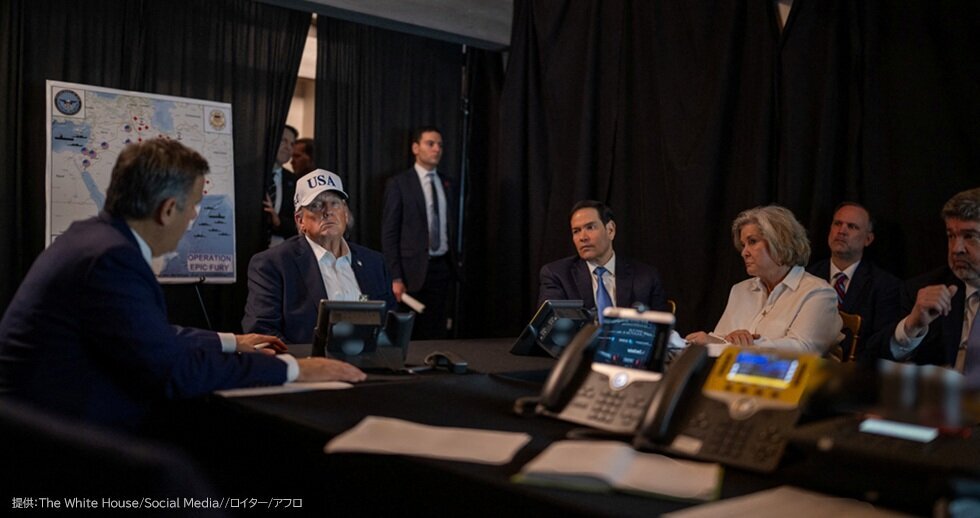
On February 28, 2026, the United States and Israel launched a large-scale military attack against Iran, during which Supreme Leader Ali Khamenei was assassinated. Iran immediately retaliated, targeting not only US military bases in Gulf states but also civilian infrastructure such as oil facilities and tourist hotels. Furthermore, the Strait of Hormuz, vital to Japan's oil imports, was effectively blockaded, rapidly escalating the situation toward full-scale military conflict in the Middle East.
US President Donald Trump has indicated that military operations could last four to five weeks or longer and has not ruled out deploying ground troops if necessary. He has also stated that he himself will be involved in selecting Iran's next Supreme Leader. Meanwhile, Israeli Prime Minister Benjamin Netanyahu has explicitly affirmed that this operation is aimed at regime change in Iran. These developments suggest the potential for repercussions beyond just a clash of arms, bringing about structural changes in the Middle East regional order.
The ongoing conflict could in fact reshape the Middle East order across three dimensions: the survival of the Iranian revolutionary regime, the security architecture of the Gulf region, and the re-emergence of great power competition in the Middle East.
This paper examines four key points: (1) the background to the US-Israel attack, (2) key strategic issues going forward, (3) future scenarios for the Iranian regime, and (4) policy implications for Japan's Middle East diplomacy.
1.Background to the US-Israel Attack
Three primary structural factors underlie this military conflict.
The first is Iran's nuclear program. Just before the attack, the US and Iran were holding nuclear talks in Geneva but negotiations broke down, significantly diminishing the prospects for a diplomatic solution. Israel has long positioned Iran's nuclear development efforts as an “existential threat” to itself. In 2025, Iran institutionalized restrictions on International Atomic Energy Agency (IAEA) inspections into domestic law, significantly reducing the transparency of its nuclear program. This heightened international concerns that Iran was rapidly advancing its nuclear weapons development capabilities.
The second is the competition for regional hegemony. Iran has expanded its influence through regional proxies. Groups such as Lebanon's Hezbollah, Yemen's Houthis, Iraq’s Shia militias, and Palestine's Hamas all receive Iranian support, and their activities significantly impact the security environment of Israel and Gulf states.
The third is the shift in US foreign strategy. Trump 2.0 has doubled down on its posture of actively using military force as a diplomatic tool, returning the “peace through strength” strategy to the forefront. The January operation in Venezuela stands as a symbolic example of this.
The primary targets during the so-called “12-Day War” in June 2025 were Iran's nuclear facilities, and the objective of the military action was to reduce that country’s nuclear weapons development capabilities. However, this most recent attack directly targeted the regime's core by seeking to eliminate Supreme Leader Khamenei. This can be interpreted as a strategic action looking beyond nuclear deterrence and pursuing a change in the Iranian regime itself.
2.Key Strategic Issues Going Forward
Four key issues will determine the outcome of this military conflict.
The first is the degree of strategic alignment between the United States and Israel. The Trump administration appears to be counting on military pressure to bring Iran to the negotiating table. Conversely, the Netanyahu government views the Iranian regime itself as a long-term threat, placing greater emphasis on weakening or changing out the regime and contending that negotiations with Iran are unnecessary. The strategies of the two countries are not perfectly aligned, and this divergence could influence the scope and duration of military action. President Trump's ever-shifting statements also represent a source of uncertainty.
The second is the geopolitical constraints of military operations. In the 2003 Iraq War, US forces reached Baghdad in a short time. However, Iran has approximately four times the land area of Iraq, and much of this is mountainous terrain. The Zagros and Elburz mountain ranges present constraints to the mobility of large-scale armored forces, making a similarly rapid armored advance difficult. Occupying and governing Iran’s large population of approximately 90 million would also require enormous military resources.
The third is the involvement of regional and major extra-regional powers. Gulf states, particularly Saudi Arabia and the United Arab Emirates, have long been at odds with Iran. Escalation of this conflict could potentially develop into a regional war. Meanwhile, Iran is highly likely to employ asymmetric strategies by mobilizing proxy forces such as Hezbollah and the Houthis.
Russia, wary of the US’s expanding influence in the Middle East, may also demonstrate some level of involvement. Notably, there are indications that Russia may be sharing intelligence with Iran in this conflict, including satellite imagery and electronic signals intelligence. Russia and Iran have strengthened their military cooperation since the start of the Ukraine war, and such intelligence support could indirectly bolster Iran's military actions.
The fourth is the issue of escalation management. It is unclear whether this operation will remain at the level of limited military pressure or escalate into a protracted conflict aimed at regime change. The escalation management capabilities of both sides will determine the scale and duration of the conflict. President Trump currently dismisses the possibility of a popular uprising by Iran's Kurds to effect regime change, arguing that it would only complicate matters. However, there is no guarantee he will not be tempted to leverage regional Kurdish forces to minimize the deployment of US troops.
This military confrontation could impact US global strategy as well. Should operations in the Middle East become protracted, strategic assets such as US Navy carrier strike groups, missile defense systems, and cruise missiles could be concentrated in the region. An extended deployment of the USS Lincoln strike group to the Middle East, for instance, might well create a certain gap in the US’s military presence in the Western Pacific. Additionally, the depletion of Tomahawk cruise missiles, missile defense interceptors and other munitions is a factor that cannot be ignored. The exhaustion of these resources in the Middle Eastern theater could have a noteworthy impact on US deterrence against China.
3.Future Scenarios for the Iranian Regime
The death of Supreme Leader Khamenei has injected significant uncertainty into Iran's political system, leading to four conceivable scenarios.
The first is a political vacuum due to succession turmoil. On March 9, the Assembly of Experts elected Khamenei's second son Mojtaba (a hardliner toward the US) as his successor. However, Israel's defense minister has already threatened to assassinate the new leader, so a decline in the Supreme Leader's status as well as turmoil across Iran during the succession process cannot be ruled out.
The second is a seizure of power by the Islamic Revolutionary Guard Corps (IRGC). The IRGC possesses not only military strength but also a vast economic network, making it likely to seize de facto power amid political turmoil.
The third is political destabilization domestically. Ayatollah Khamenei's death could energize anti-regime movements, but it also heightens the likelihood of intensified suppression by security forces. The potential for exiled opposition forces and pro-American factions to expand their influence appears limited at this stage.
The fourth is a collapse of state governance. Should Iran descend into civil war, extremist groups such as the Islamic State (IS) might expand their influence as far as the Gulf States.
In all these scenarios, the IRGC is likely to remain central to regime preservation in the short term. Prolonged military conflict and economic sanctions may deepen political instability, though, so the future of the Iranian regime will remain very much up in the air for the foreseeable future.
4.Policy Implications for Japan's Middle East Diplomacy
This crisis directly impacts Japan's energy security. Japan relies on the Middle East for approximately 95% of its crude oil, making a blockade of the Strait of Hormuz a major strategic risk.
While Japan has maintained relatively good diplomatic relations with Iran, its future diplomacy will place greater importance on relations with the Gulf Arab states, particularly Saudi Arabia. The Shinzo Abe administration did strengthen ties with Middle Eastern countries through summit diplomacy, but this momentum has dropped off in recent years.
Should securing the Strait of Hormuz prove difficult, the involvement of the Maritime Self-Defense Force (MSDF) may be required to ensure the safety of Japan-related vessels. In past periods of Middle East tension, the Self-Defense Forces have been dispatched to gather information and conduct surveillance and monitoring of Japan-related vessels. If the current situation persists, SDF escort and surveillance missions to ensure the safety of Japanese merchant ships and tankers could once again emerge as a policy issue.
Given the dramatically changing circumstances in the Middle East, Japan must rebuild its regional diplomacy with a particular emphasis on the following: (1) ensuring the safety of energy transport routes, (2) pursuing closer security cooperation with Gulf nations, and (3) seeking a diplomatic role in easing regional tensions.
Conclusion
The recent US-Israel attack on Iran has the potential to evolve beyond a straightforward military clash into a catalyst that significantly alters the political order in the Middle East. With the fate of the Iranian regime, the involvement of regional powers, and the impact of great power competition becoming intricately intertwined, the Middle East is undoubtedly heading into a new era of instability.
Moreover, this crisis may impact the allocation of US strategic resources, with potential spillover effects extending to the security environment in the Indo-Pacific region. Japan must therefore view this Middle East crisis not simply as a distant conflict but as an issue closely linked to its own security and formulate a strategic and long-term diplomatic response.
(This is an English translation of a Japanese paper originally published on March 10, 2026)