


OverView
Messages
OKA Motoyuki, Chairman
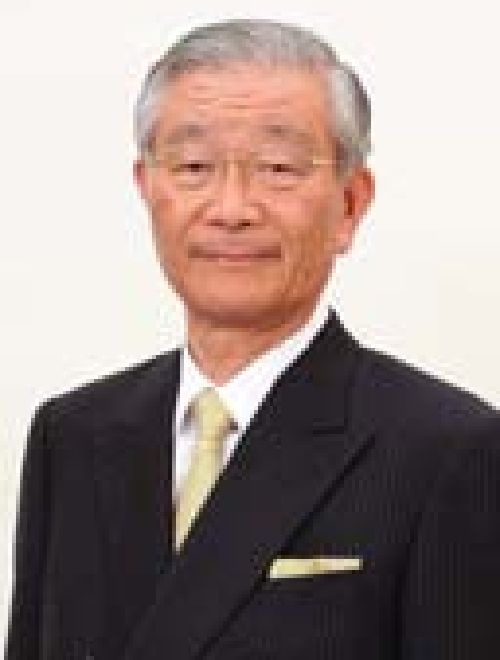
JIIA is a comprehensive foreign policy/security think-tank established in December 1959 at the urging of former Prime Minister Shigeru Yoshida and modelled on the Royal Institute of International Affairs (Chatham House) and other institutions. Mr. Yoshida chaired the newly established JIIA, and the institute received strong and wide-ranging support from politicians in both ruling and opposition parties, leaders from the business community, and prominent experts from academia and media circles.
In September 1960 JIIA was authorized as an incorporated foundation affiliated with the Ministry of Foreign Affairs, and in March 1963 it received certification as a corporate body making special contributions to the public interest, a status that made it eligible for certain tax incentives. Following amendment of the Act on General Incorporated Associations and Foundations, JIIA was certified as a public interest incorporated foundation in March 2012, and in April of that year it transitioned into the public interest incorporated foundation that it remains today.
The world has entered an era of dramatic change, making it all the more important to marshal the human resources and wisdom of government, industry and academia to address foreign policy and security issues, and to inform the world of Japan's approaches and contributions. To promote growth and development into the future for both Japan and the rest of the world, JIIA will build on its persistent research endeavors by stepping up its efforts to disseminate information worldwide through networking with research institutions and experts overseas, and by cultivating greater interest in foreign policy and security issues within Japan. Your understanding and support of JIIA's activities would be very much appreciated.
SASAE Kenichiro, President
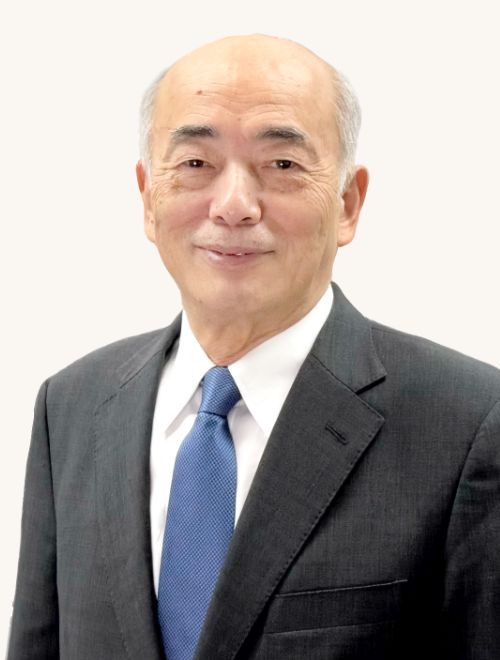
The Japan Institute of International Affairs (JIIA), over its history of more than half a century, has put forward ideas and information analysis to experts and leading figures, among them Japanese domestic and foreign policy makers, researchers and media representatives, by conducting studies/research on Japan's foreign policy and security and by developing policy recommendations.
These activities have not only made JIIA one of Japan's leading think tanks on foreign policy and security issues, but have also given it a solid reputation internationally as the most recognized think tank in Asia. JIIA has held numerous policy dialogues and symposiums with other leading think tanks worldwide to present its research on Japan's foreign and security policies, as well as various policy recommendations.
To give Japan a greater intellectual presence globally, JIIA will continue conducting studies, undertaking research, and making recommendations connected with policy making, will publicize Japan's views to opinion leaders across the rest of the world, will provide relevant information both inside and outside Japan, and will cultivate world-class researchers in the areas of foreign policy and security.
All of JIIA's staff are fully committed to ensuring that JIIA can offer policy recommendations and information analysis to strengthen Japan's presence on the world stage and achieve peace and prosperity for both Japan and the rest of the world with an eye to the next fifty years. We ask your continued understanding and support, and we would be grateful for your frank opinions and guidance as we move forward.
Research Centers
JIIA is composed of research centers, each with its own purpose and function. The Institute collects and organizes books, documents, and materials, which are available to the public in the Reference Room. These books and materials are useful for research and studies at the Institute and are available to the public by reservation.
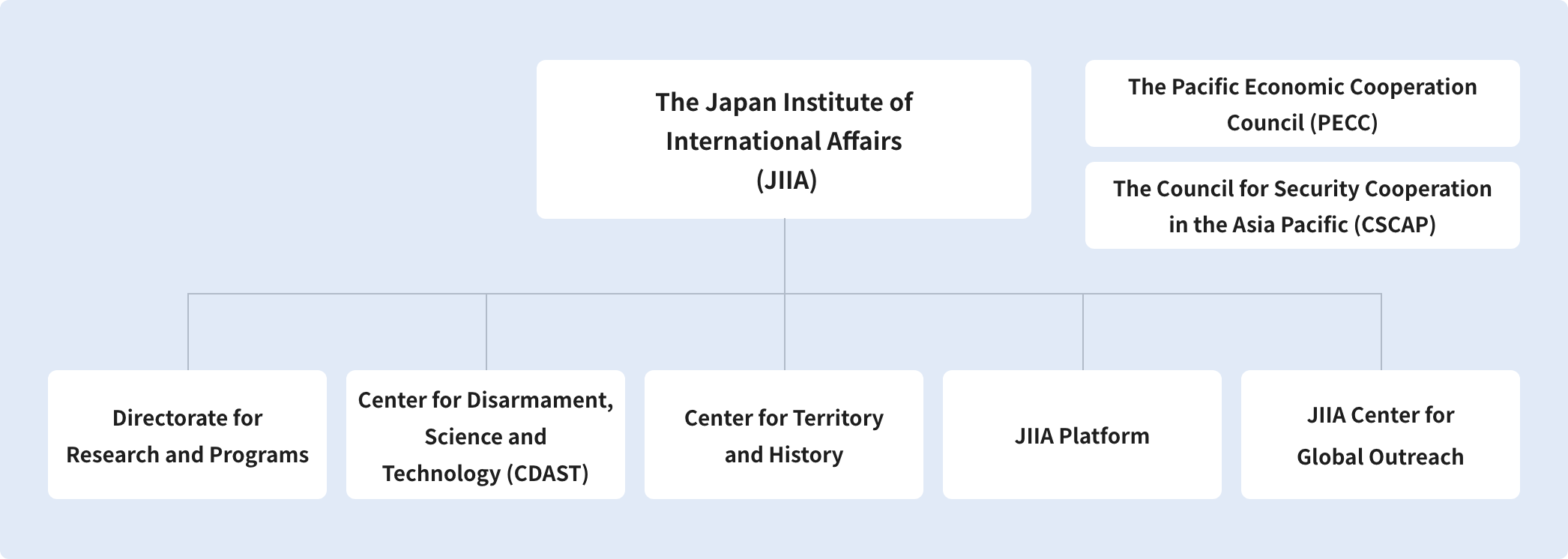

Directorate for Research and Programs
In response to the needs of the times, JIIA has conducted research projects to develop analyses and policy proposals that are useful for planning foreign and security policies. Reports on our research projects' activities are posted in this section as needed.
Center for Disarmament, Science and Technology (CDAST)
Following the end of the Cold War, the international community became more committed than ever before to strengthening disarmament and non-proliferation efforts. The collapse of the Cold War structure, which had resulted in a confrontation between the East and West, brought about a new international trend of pursuing these goals. However, the end of the Cold War also intensified destabilizing factors against world peace, such as ethnic conflicts. This made promoting disarmament and non-proliferation as settlement measures more urgent.
Against this backdrop, in July 1995, then-Foreign Minister Yohei Kono advocated for the establishment of a national framework that would place greater emphasis on disarmament and non-proliferation activities. As part of these efforts, the Center for Disarmament, Science and Technology (CDAST) was established at JIIA in July 1996.
Center for Territory and History
In 2017, JIIA established the Center for Territory and History to conduct research and public outreach activities in the fields of territory, sovereignty, and history.
The Center carries out the following activities:
1. Collecting, organizing, and disseminating domestic and international materials related to Japan's territory, sovereignty, and history;
2. Hosting public symposia on these topics, both domestically and internationally.
3. Conducting research and studies related to these fields.
JIIA Platform
In 2025, JIIA established the JIIA Platform, a project that aims to build a strategic base for interactions and exchanges of ideas among government officials, corporate representatives and academics, and to deliver policy recommendations. We will assemble high-level wisdom from political, governmental, business, and academic circles to discuss the path Japan should take, and we plan to compile the knowledge gained from these discussions into a national strategy.
The Pacific Economic Cooperation Council (PECC)
JIIA serves as the secretariat of the Japan National Committee for the Pacific Economic Cooperation (JANCPEC). Ambassador Kenichiro Sasae is the JANCPEC chair.
The PECC is an independent and unofficial regional mechanism that promotes economic cooperation and market-driven integration. It is a unique partnership of business, government, and intellectual leaders who advocate for economic growth, social progress, scientific and technological development, and environmental conservation in their personal capacities. Founded in 1980 by then-prime ministers Masayoshi Ohira of Japan and Malcom Fraser of Australia, PECC organizes task forces, project groups, and forums. It has twenty-four full member committees and one associate member from economies in the Pacific region. JANCPEC has over 80 representatives from industry, government, and academia.
The Council for Security Cooperation in the Asia Pacific (CSCAP)
The Japan Institute of International Affairs along with nine other international policy and research institutes established CSCAP in 1993 in Kuala Lumpur. CSCAP is a non-governmental "Track II" process for multilateral security dialogue in the Asia-Pacific region. Its membership has expanded and today includes institutes representing Australia, Brunei, Cambodia, Canada, China, the EU, India, Indonesia, Japan, North Korea, South Korea, Malaysia, Mongolia, New Zealand, Papua New Guinea, the Philippines, Russia, Singapore, Thailand, the United States and Vietnam. CSCAP members seek to enhance regional security and stability through consultations and cooperation on policy issues and problems of mutual concern. CSCAP often addresses issues that are too sensitive for official dialogue, and supports and complements the efforts of governmental, "Track I" multilateral dialogue mechanisms such as the ASEAN Regional Forum (ARF).
Mission and Endeavors
The Institute's aims shall be to conduct research on international affairs and scientifically examine Japan's foreign policy to provide a constructive framework for formulating such policy; disseminate knowledge and information on international affairs and encourage research on international affairs by universities and research groups throughout Japan; assist in shaping world opinion favorably toward Japan and ensuring the sound administration of Japan's foreign affairs; and contribute willingly to world peace and prosperity.
The Institute shall undertake the following endeavors in order to achieve the aforementioned aims.
-
01Research studies and policy recommendations pertaining to international affairs
For each research project, we will bring together researchers, experts, and practitioners who have in-depth knowledge of their respective fields. They will provide feedback on research results to the government, make policy recommendations, and disseminate research results to the public. While conducting high-quality surveys, research, and policy recommendations, we will also pay attention to cross-thematic collaboration. We will disseminate research findings as reports on our website and submit them to the government in the form of policy recommendations. Additionally, public symposia, such as the Tokyo Global Dialogue, will be held to provide opportunities for widespread dissemination both domestically and internationally.
-
02Dialogue and exchange on international affairs with Japanese and foreign universities, research institutions, research groups, among others.
"Dialogue and exchange on international affairs with Japanese and foreign universities and research institutions" are useful activities for disseminating the research results and policy recommendaitons to the public. We will continue to actively promote intellectual exchange with domestic and overseas universities and research institutions.
As part of each research project, we will consult with, conduct joint research with, and hold joint symposia with overseas universities and research institutions. We will also strive to maximize the effectiveness of our external information dissemination and lecture activities. We will also develop new online partnerships and strive for further expansion.
Through these efforts, we aim to promote Japan's position, role, and contributions to the international community, fostering favorable international public opinion of Japan and deepening understanding among countries regarding diplomatic and security issues. -
03Endeavors pertaining to the Comprehensive Test Ban Treaty (CTBT), among others.
Based on a three-year commission from the Ministry of Foreign Affairs, we will continue to perform our duties as the secretariat of the National Operating System for the CTBT. Specifically, we will collaborate with two national data centers--NDC-1, the Japan Weather Association (JWA), and NDC-2, the Japan Atomic Energy Agency (JAEA)--to develop, operate, and maintain the domestic operational system for monitoring nuclear tests.
-
04Diffusion of knowledge and dissemination of information inside and outside Japan on the aforementioned endeavors and on other international issues through electronic media, magazines, books and other publications as well as seminars, lectures, discussion meetings, and similar gatherings
We will actively participate in shaping international public opinion by disseminating the insights, arguments, and recommendations gained from our research projects both domestically and internationally. We will also promote public understanding of diplomatic and security issues.
In light of the growing importance of information dissemination activities in today's international environment and IT-driven society, we will leverage online and hybrid-format conferences and webinars to widely disseminate the findings of our research projects and expert opinions on new issues arising from changes in the situation, both domestically and internationally. We will also share these findings with our corporate and individual members, as well as embassies in Tokyo and other interested parties both domestic and international, to promote theour institute's activities. -
05Other endeavors deemed necessary to achieve the Institute's aims
Contact Us / Access
3rd Floor Toranomon Daibiru-East Building 3-8-1 Kasumigaseki Chiyodaku, Tokyo Japan 100-0013
Tel: 03-3503-7261 +81-3-3503-7261 (from outside Japan)
Fax: 03-3503-7292 +81-3-3503-7292 (from outside Japan)
Qualified Invoice Issuer (Invoice) Registration Number
T2010005018803